
AI agents are no longer answering questions on the side. In many companies they now approve transactions, change records, and trigger work in other systems. A new survey shows what happens when that authority arrives before the data and the workflow are ready.
On 8 October 2026, Optro (formerly AuditBoard) published Authority without oversight: The 2026 agentic enterprise report. It surveyed 417 decision-makers in internal audit, risk, compliance, and information security at organizations with 250 or more employees in North America and Europe.
What the report found
- 34% of organizations have experienced an inaccurate agent decision or output that was acted upon.
- 30% have seen an AI agent take an unintended action, and 25% have had a control failure involving an agent.
- 38% let agents approve or reject transactions, 34% let them modify controls or policies, and 27% let them change user permissions or access rights.
- 96% agree workflows should adapt to use AI, but only 9% have redesigned workflows to accommodate agents safely.
- 46% say employees now spend more time reviewing, validating, or correcting AI outputs.
Optro sells governance, risk, and audit software, so the findings come from a vendor-sponsored study. The pattern is still hard to ignore: organizations have handed agents real authority without rethinking how those decisions are checked.
Where trusted data was not considered
The report does not say what caused each wrong decision. In our experience, agent errors rarely start with the model. They start with the inputs and the permissions around it: an agent reads an outdated record, works from a partial view of the customer, or holds credentials broader than its task requires.
An incident reported in May 2026 showed how fast the last of these can go wrong. An AI coding agent at the software company PocketOS was doing a routine task in a staging environment when it hit a credential mismatch. It found an API connection unrelated to its task that had the authority to delete, and it removed a cloud storage volume holding the production database. The latest backups were on the same volume, and there was no confirmation step. The cloud provider later recovered the data. Nobody intended the agent to have that reach. It simply had it.
Lessons learned
- Match autonomy to data quality and reversibility. Let agents act alone only where the data is trusted and the action is easy to undo. Everything else gets a human approval step.
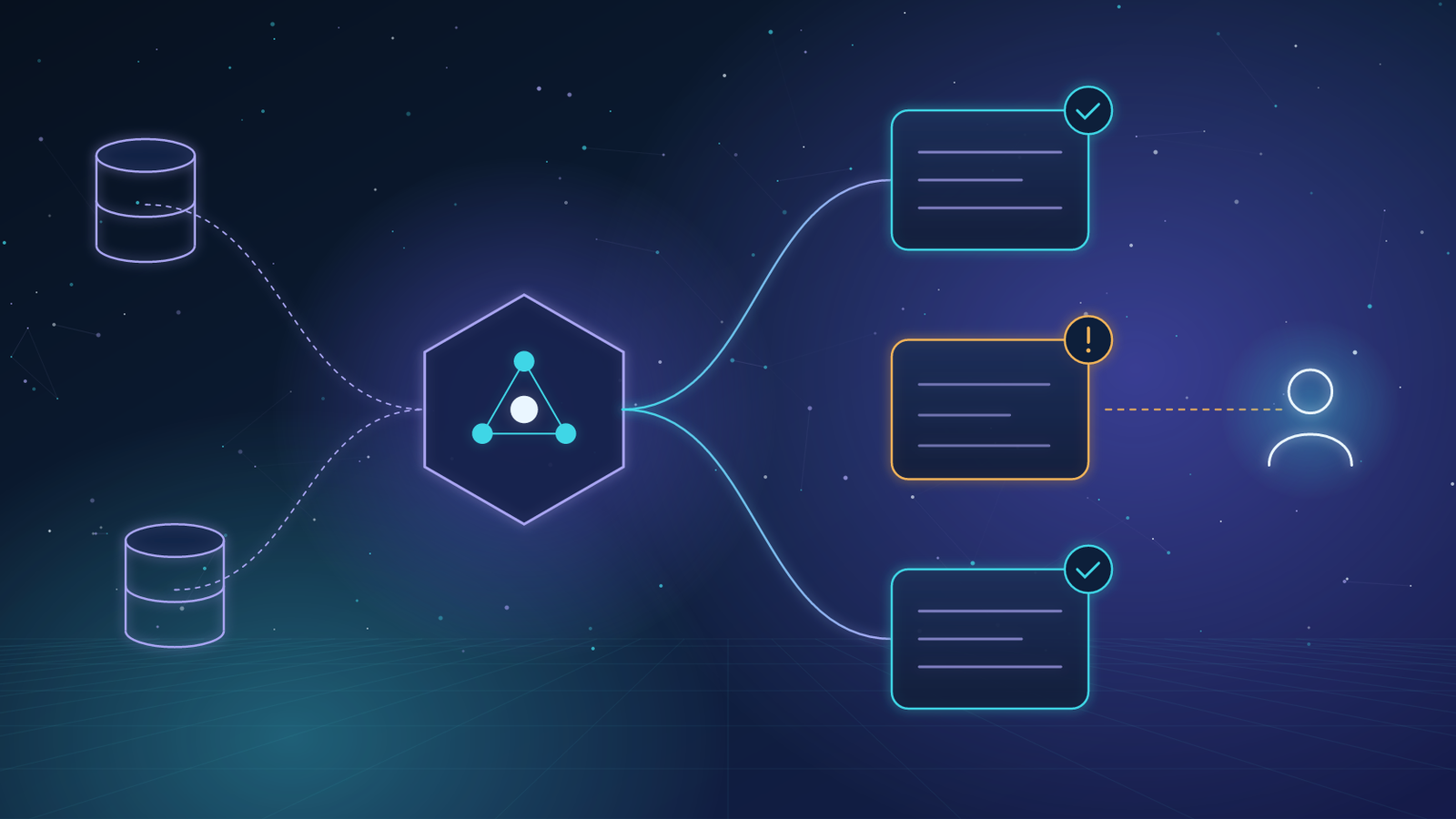
- Redesign the workflow, not just the task. Decide where the agent reads, where it acts, who approves, and how exceptions return to a person. Bolting an agent onto an old process is how the gap between the 96% and the 9% appears.
- Scope access to the job. Give each agent its own identity with least-privilege access, keep production separate from test environments, and store backups where an agent cannot delete them.
- Log every decision with its inputs. Record what the agent read, what it decided, and what it changed, so a wrong decision can be traced and reversed.
- Measure review time as a cost. If people spend hours correcting agent output, the data or the design needs fixing before the agent scales.
What this means for your AI program
Agents create value when they act on data you trust, inside a workflow designed for them. Our Agent Launch package delivers one workflow with human approvals, scoped access, and a full audit trail, and AI Trust & Guardrails puts evaluation and monitoring around the agents you already run. Not sure where to start? The AI Strategy & Opportunity Sprint ranks your use cases and checks your data readiness in two weeks.